Introduction
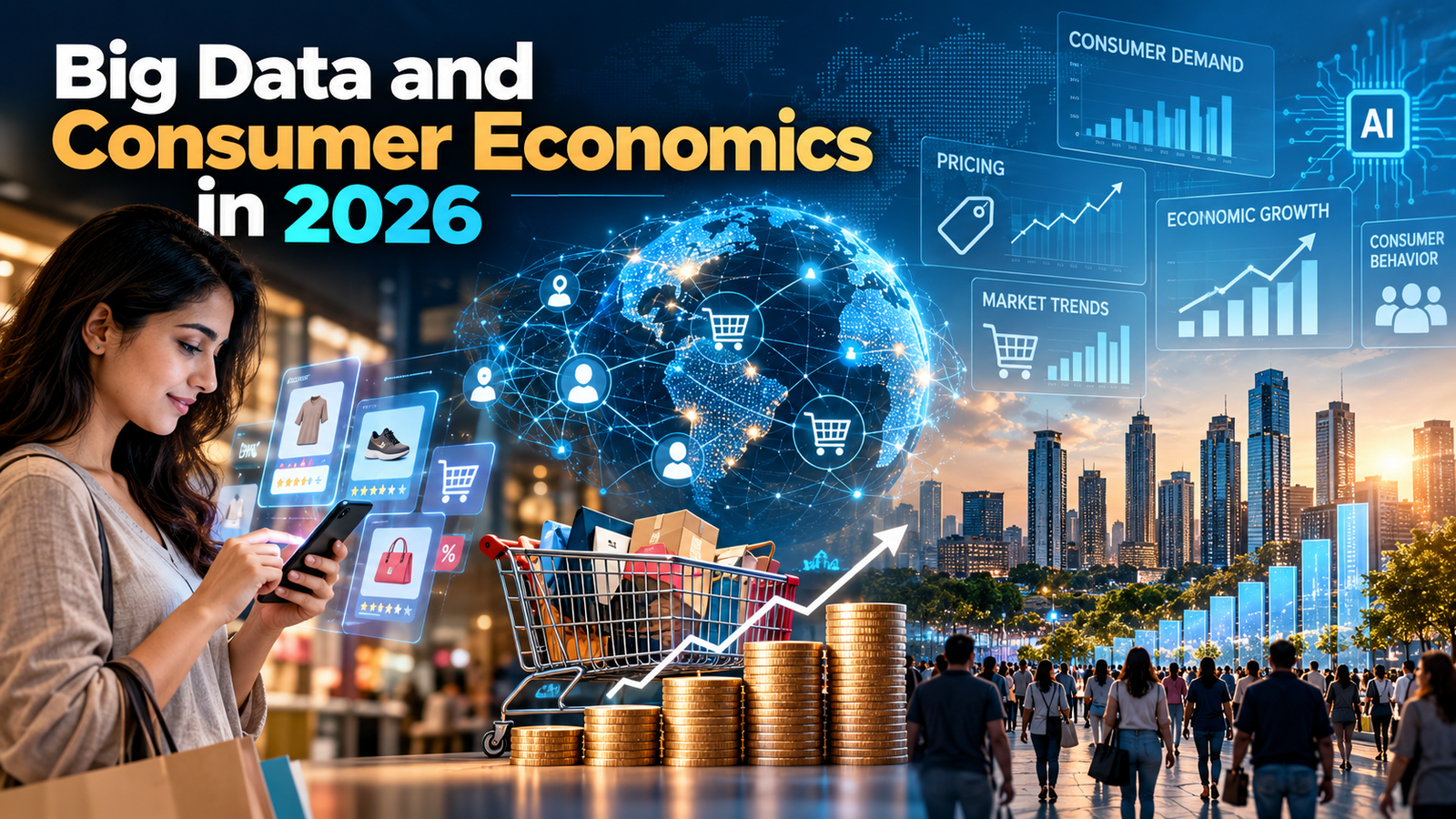
The global economy in 2026 is increasingly influenced by the collection, processing, and analysis of enormous amounts of digital information. From online shopping and mobile banking to artificial intelligence and digital payment systems, Big Data has become an essential component of modern economic activity. Its growing importance has transformed Consumer Economics, creating new opportunities for businesses, governments, and individual consumers.
Traditionally, Consumer Economics focuses on how individuals and households allocate limited resources to satisfy their unlimited wants. It examines consumer demand, purchasing power, utility maximization, price elasticity, and market behavior. However, the expansion of Big Data has introduced new dimensions to these economic concepts.
Today, businesses can analyze millions of transactions, predict consumer demand, optimize product prices, and develop personalized marketing strategies. Meanwhile, consumers can compare prices, access financial services, and make purchasing decisions through digital platforms.
The integration of Big Data into Consumer Economics has significant implications for market efficiency, competition, productivity, inflation, and economic growth. However, it also raises concerns about market concentration, price discrimination, consumer welfare, and unequal access to economic opportunities.

This article examines how Big Data is reshaping Consumer Economics in 2026, focusing on its applications, economic advantages, limitations, and implications for the future of global and Indian markets.
Table of Contents
Understanding Big Data in Consumer Economics
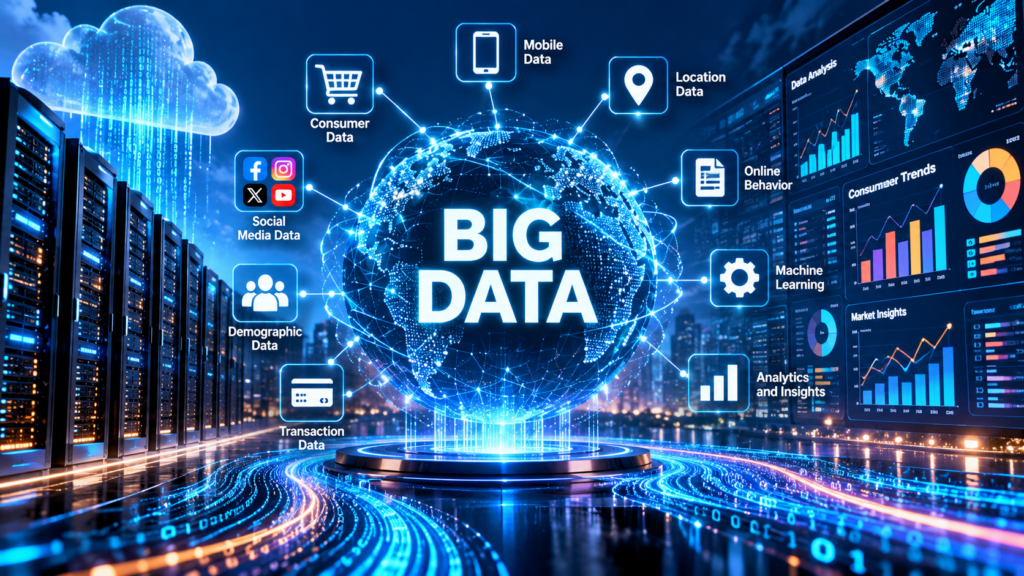
Big Data refers to large and complex collections of information that require advanced technologies for storage, processing, and analysis. In economic markets, this information comes from consumer transactions, digital payments, online searches, e-commerce platforms, financial institutions, and mobile applications.
In Consumer Economics, Big Data provides valuable insights into consumer preferences, purchasing patterns, income-related spending behavior, and responses to changes in market prices.
For example, an online retailer can analyze purchasing histories to determine which products are frequently purchased together. A supermarket can study seasonal demand for essential commodities, while a financial institution can use transaction data to assess customer spending patterns.
These applications improve the accuracy of economic forecasting and business decision-making.
Traditional Consumer Economics often relies on surveys, household expenditure studies, and historical market statistics. Big Data complements these methods by providing more frequent and detailed observations of consumer activity.
Nevertheless, digital records do not represent every household equally. Cash purchases, informal markets, and consumers with limited digital access may remain underrepresented. Therefore, economists must combine digital information with representative statistical methods to obtain reliable conclusions.
Big Data and Consumer Demand Analysis
Consumer demand is one of the fundamental concepts of microeconomics. According to the law of demand, the quantity demanded of a product generally decreases when its price increases, assuming other factors remain constant.
Big Data has significantly improved the ability of economists and businesses to analyze this relationship.
In modern Consumer Economics, companies use advanced analytical tools to examine how consumers respond to price changes, income fluctuations, promotional campaigns, and economic uncertainty.
For example, an e-commerce platform may analyze the sales performance of a smartphone at different prices. By comparing purchasing behavior across customer segments, the company can estimate demand elasticity and identify prices that generate greater revenue.
Big Data also helps businesses understand the influence of substitute and complementary goods. When the price of one product increases, consumers may shift toward cheaper alternatives. Data analytics can identify these substitution patterns more quickly than traditional market research.
This information allows businesses to forecast demand, manage production, and reduce unnecessary inventory.
In Consumer Economics, accurate demand forecasting can improve resource allocation by ensuring that products are available where and when consumers need them.
However, demand predictions must account for external economic factors such as inflation, employment conditions, interest rates, and changes in household income.
Price Elasticity and Data-Driven Pricing
Price elasticity of demand measures the responsiveness of consumer demand to changes in product prices.
It can be expressed as:
Price Elasticity of Demand (PED) = Percentage Change in Quantity Demanded ÷ Percentage Change in Price
Big Data allows businesses to estimate price elasticity using large volumes of transaction data.
For example, suppose a retailer increases the price of a product by 10%, resulting in a 15% decline in quantity demanded.
The price elasticity of demand would be:
PED = −15% ÷ 10% = −1.5
Since the absolute elasticity is greater than one, demand is relatively elastic.
In Consumer Economics, this information helps businesses understand whether increasing or decreasing prices is likely to improve total revenue.
Data-driven pricing can also account for seasonal demand, geographical differences, consumer preferences, and competitor prices.
However, the growing use of algorithmic pricing creates economic concerns. Companies may use information about individual purchasing behavior to estimate willingness to pay and offer different prices or discounts.
While price differentiation can sometimes expand market participation, it may also allow firms to capture a larger share of consumer surplus.
Therefore, modern Consumer Economics must examine whether data-driven pricing improves overall economic welfare or primarily increases corporate profits.
Artificial Intelligence and Predictive Consumer Economics

Artificial intelligence has become an important technological instrument in Consumer Economics. Machine-learning algorithms can analyze historical transactions, identify purchasing patterns, and forecast future consumer behavior.
Predictive analytics helps businesses estimate future demand and adjust production accordingly.
For example, a clothing retailer may analyze previous sales, seasonal preferences, regional purchasing patterns, and promotional responses to predict demand for winter clothing.
Similarly, grocery retailers can use forecasting models to reduce shortages and minimize the wastage of perishable products.
In Consumer Economics, these technologies can lower operational costs and improve supply-chain efficiency.
Artificial intelligence also supports personalized product recommendations, automated customer services, financial planning tools, and fraud detection.
The economic benefits include lower search costs, improved inventory management, faster transactions, and potentially higher productivity.
However, predictive systems can produce inaccurate results when economic conditions change unexpectedly. Historical purchasing behavior may not reliably predict future demand during recessions, supply disruptions, or periods of rapid inflation.
Therefore, economists must evaluate AI predictions using statistical testing, economic theory, and changing market conditions.
Big Data and Market Efficiency
Market efficiency refers to the ability of markets to allocate resources effectively while minimizing unnecessary costs.
In traditional economic theory, imperfect information can prevent buyers and sellers from making optimal decisions.
Big Data can reduce some of these information gaps.
Consumers can compare product prices across online platforms, read reviews, examine specifications, and identify suitable alternatives. Businesses can analyze demand trends and adjust production to match consumer requirements.
These developments can improve allocative efficiency and productive efficiency.
In Consumer Economics, allocative efficiency occurs when resources are distributed in a way that maximizes total economic welfare under the relevant market assumptions.
Productive efficiency occurs when goods and services are produced at the lowest feasible cost.
Big Data can support both forms of efficiency by improving demand forecasts, reducing inventory waste, and optimizing logistics.
For example, a retailer using accurate sales predictions may avoid excessive inventory while maintaining sufficient stock to satisfy customers.
Nevertheless, greater access to data does not automatically produce perfectly competitive markets. Firms with exclusive datasets, powerful digital platforms, and advanced algorithms may gain advantages that smaller competitors cannot easily match.
Thus, the relationship between Big Data and Consumer Economics involves both efficiency gains and the possibility of increased market power.
Big Data and Consumer Surplus
Consumer surplus represents the difference between the maximum price a consumer is willing to pay and the actual market price.
It is an important measure of consumer welfare in microeconomics.
Suppose a consumer is willing to pay ₹1,000 for a product but purchases it for ₹800. The consumer surplus is ₹200.
Big Data can influence consumer surplus in several ways.
Price-comparison platforms may help consumers discover lower prices, increasing their surplus. Personalized recommendations may reduce the time and effort required to find suitable products.
However, businesses can also use consumer information to estimate willingness to pay more accurately.
If a company identifies consumers who are willing to pay higher prices, it may design pricing strategies that capture some of the surplus those consumers would otherwise enjoy.
This creates a significant issue in Consumer Economics because higher producer profits do not necessarily indicate higher consumer welfare.
The distribution of economic benefits depends on competition, pricing transparency, consumer bargaining power, and the availability of substitutes.
In 2026, the OECD has emphasized the importance of examining competition and consumer protection together in digital markets, particularly where algorithmic recommendations and personalized pricing influence consumer choices.
Digital Platforms and Market Competition
Digital platforms have transformed the structure of modern markets by connecting millions of buyers and sellers.
E-commerce marketplaces, food-delivery applications, online travel services, and digital financial platforms use Big Data to coordinate economic transactions.
In Consumer Economics, these platforms can reduce transaction costs and expand market access.
Small businesses may reach customers beyond their immediate geographical areas, while consumers gain access to a wider range of products.
However, digital markets frequently exhibit network effects. A platform may become more valuable as additional buyers, sellers, or users participate.
Network effects can encourage rapid market growth, but they may also contribute to market concentration.
Large platforms often possess extensive consumer datasets, advanced analytical infrastructure, and substantial financial resources.
These advantages may create barriers to entry for smaller firms.
In July 2026, the OECD highlighted structural competition risks in artificial intelligence markets, including concentration in computing infrastructure, access to data, and specialized skills.
For Consumer Economics, the central concern is whether technological development promotes competition or strengthens the dominance of established companies.
Effective competition policy is therefore necessary to prevent anti-competitive practices while preserving incentives for innovation.
Big Data, Inflation and Consumer Spending
Inflation affects Consumer Economics by reducing the purchasing power of money when nominal household income does not rise at the same pace as prices.
Big Data can help economists analyze changes in consumer prices and spending behavior.
Traditional inflation measurement relies on carefully designed price surveys and expenditure weights. Digital transaction data and online price information can supplement these established methods.
For example, economists may analyze online retail prices to identify changes in the cost of household goods. Payment data can also provide timely indicators of consumer spending.
These methods can help researchers understand how inflation affects different income groups.
Low-income households generally spend a larger proportion of their budgets on necessities such as food, housing, and transportation. As a result, price increases in essential goods can have particularly serious consequences for their financial welfare.
Consumer Economics examines how households adjust consumption when their real income declines.
Some consumers may switch to cheaper brands, reduce discretionary spending, or postpone expensive purchases.
Big Data can identify these changes at a more detailed level, although transaction data alone cannot establish the causes of inflation.
Inflation is influenced by monetary conditions, production costs, supply disruptions, expectations, and aggregate demand.
Therefore, data-driven consumption analysis should complement broader macroeconomic research rather than replace it.
Consumer Economics and the Digital Payment Economy
Digital payment systems are transforming Consumer Economics by making transactions faster, more convenient, and easier to record.
Mobile wallets, payment applications, online banking, and real-time payment systems reduce certain transaction costs associated with cash handling and traditional payment methods.
Digital payments can also support financial inclusion by helping consumers and small businesses participate in formal financial systems.
In India, the Unified Payments Interface (UPI) has become a major component of the digital economy.
According to the National Payments Corporation of India, UPI processed approximately 24.07 billion transactions worth ₹29.37 lakh crore in September 2026.
The scale of these transactions illustrates the growing economic importance of digital payment infrastructure.
From the perspective of Consumer Economics, digital payments can improve convenience, reduce payment friction, and create new opportunities for online and offline commerce.
Transaction information can also support financial analysis, subject to privacy protections, appropriate authorization, and applicable legal requirements.
However, the expansion of digital payments introduces challenges related to cybersecurity, payment fraud, infrastructure costs, and digital exclusion.
The economic success of digital payments depends not only on transaction volume but also on affordability, reliability, competition, and accessibility.
Big Data and Household Consumption Expenditure
Household consumption expenditure is a major component of aggregate demand and national income.
Under the expenditure approach, Gross Domestic Product is commonly expressed as:
GDP = C + I + G + (X − M)
Where:
- C = Household final consumption expenditure
- I = Investment
- G = Government expenditure on goods and services
- X − M = Net exports
Consumer Economics is closely connected with the consumption component of GDP.
Big Data can help economists estimate changes in household spending by examining retail sales, digital transactions, and other economic indicators.
For example, a sustained increase in discretionary purchases may indicate improving consumer confidence, although the interpretation depends on prices, income, borrowing, and other conditions.
Likewise, declining purchases of non-essential products may indicate financial uncertainty or changes in household priorities.
These insights can help businesses make investment decisions and support economic forecasting.
Nevertheless, digital spending information must be interpreted cautiously because it may exclude cash transactions and informal economic activities.
A comprehensive analysis of Consumer Economics requires integrating digital information with household surveys, national accounts, employment statistics, and other official economic indicators.
Big Data and Business Profitability
Profit maximization is an important objective of many private businesses.
Big Data can improve profitability by reducing costs, strengthening demand forecasts, and identifying profitable market opportunities.
Businesses can use data analytics to understand customer retention, purchasing frequency, product performance, and advertising effectiveness.
In Consumer Economics, customer lifetime value is one useful concept for evaluating long-term business relationships.
Customer lifetime value estimates the economic contribution a customer is expected to generate over the duration of their relationship with a business.
A retailer may use this information to decide how much to spend on customer acquisition and retention.
Big Data also supports inventory optimization and supply-chain management.
For example, a supermarket may use demand forecasts to order appropriate quantities of perishable goods. This can reduce spoilage, storage costs, and lost sales.
However, implementing advanced analytics involves expenditure on software, infrastructure, skilled employees, cybersecurity, and data governance.
Businesses must compare these costs with the expected economic benefits.
For small enterprises, affordable analytical tools and accessible digital infrastructure may be more practical than expensive proprietary systems.
Consumer Economics and Economic Inequality
The economic benefits of Big Data are not equally distributed.
Large corporations often have greater financial resources to invest in artificial intelligence, cloud computing, and advanced analytics.
Small businesses may struggle to access comparable technologies.
Similarly, consumers with reliable internet access and digital literacy may benefit more from online price comparisons, financial applications, and digital marketplaces.
This creates important distributional questions within Consumer Economics.
Digital inequality can influence purchasing opportunities, access to financial services, and the ability to obtain competitive prices.
Data-driven credit assessment may expand access for some underserved borrowers, but poorly designed systems can also reinforce existing financial inequalities.
Economists must therefore distinguish between improvements in total economic output and improvements in the distribution of economic welfare.
A technological innovation may increase overall efficiency while leaving certain households or businesses worse off.
Inclusive Consumer Economics requires policies that promote digital infrastructure, financial education, affordable technology, and fair market participation.
Big Data and Consumer Economics in India in 2026
India presents significant opportunities for the application of Big Data in Consumer Economics.
The expansion of digital payments, e-commerce, financial technology, and mobile internet services has created new channels for consumer transactions.
Indian businesses can use data analytics to understand regional demand, improve supply chains, and develop products for different income groups.
For example, retailers may analyze seasonal demand during major festivals to manage inventory and distribution.
Agricultural markets can benefit from improved demand forecasting, while small enterprises can use digital sales information to understand customer preferences.
The growing digital economy also creates opportunities for financial technology companies to offer budgeting services, digital payments, and other financial products.
However, India’s economic diversity presents challenges.
Consumption patterns vary considerably between urban and rural areas, formal and informal markets, and households with different income levels.
Consumer Economics in India must therefore account for differences in purchasing power, infrastructure, employment, and access to financial services.
Government policies that support digital literacy, competition, consumer protection, and infrastructure development can help ensure that the benefits of Big Data reach a broader population.
Challenges of Big Data in Consumer Economics
Despite its economic advantages, Big Data presents several challenges.
One major concern is information asymmetry. Companies may possess detailed knowledge about consumer preferences and purchasing behavior, while consumers have limited understanding of how their information influences prices and recommendations.
This imbalance can weaken consumer bargaining power.
Another challenge is algorithmic price discrimination. Personalized pricing may allow businesses to charge different consumers different prices based on estimated willingness to pay.
Although some forms of price discrimination can improve market access, others may reduce consumer surplus or create unfair outcomes.
Data security also has economic consequences. Cyberattacks and unauthorized data access can impose financial losses on businesses and households.
Furthermore, the concentration of data among dominant companies can restrict competition and discourage new market entrants.
Consumer Economics must evaluate these risks alongside the productivity and efficiency gains created by digital technologies.
Appropriate regulation, transparency, competition enforcement, and consumer education are essential for maintaining trust in digital markets.
The Future of Consumer Economics Beyond 2026
The future of Consumer Economics will increasingly involve artificial intelligence, predictive analytics, automated financial services, and real-time market information.
Businesses are likely to continue investing in technologies that improve demand forecasting, customer engagement, and operational efficiency.
Consumers may benefit from more sophisticated budgeting applications, personalized financial tools, and improved access to market information.
AI-based shopping assistants could reduce search costs by comparing prices and product characteristics across multiple sellers.
However, their economic value will depend on whether recommendations serve consumers’ interests or prioritize commercial arrangements.
Big Data may also improve economic policymaking by providing more timely information about consumer spending and market conditions.
Nevertheless, technological innovation alone cannot guarantee higher economic welfare.
Competitive markets, reliable institutions, financial inclusion, and effective consumer protection will remain essential.
The long-term objective of Consumer Economics should be to use digital information to improve economic efficiency while ensuring that the resulting benefits are distributed fairly among consumers, businesses, and society.
Conclusion
Big Data is transforming Consumer Economics in 2026 by changing how businesses analyze demand, determine prices, manage resources, and compete in digital markets.
Its integration with artificial intelligence and predictive analytics offers opportunities to improve productivity, reduce transaction costs, strengthen market efficiency, and support economic growth.
At the same time, data-driven markets present challenges related to consumer surplus, price discrimination, market concentration, financial inequality, and information asymmetry.
From a microeconomic perspective, Big Data influences demand elasticity, pricing decisions, consumer choice, and market competition. From a macroeconomic perspective, it provides additional information about household expenditure, inflation, consumption trends, and economic activity.
The future of Consumer Economics will depend on balancing technological innovation with competitive markets, responsible data governance, and consumer welfare.
Ultimately, Big Data should not merely help businesses maximize profits. It should also contribute to a more efficient, inclusive, and sustainable economic system.
References and Further Reading
- Organisation for Economic Co-operation and Development (OECD). (2026). Competition and Consumer Policy in Digital Markets. https://www.oecd.org/en/publications/competition-and-consumer-policy-in-digital-markets_042c0c49-en.html
- OECD. (2026). Artificial Intelligence Markets. https://www.oecd.org/en/publications/artificial-intelligence-markets_d531d73f-en/full-report.html
- National Payments Corporation of India (NPCI). (2026). Unified Payments Interface: Product Statistics. https://www.npci.org.in/product/upi/product-statistics
- OECD. (2026). Artificial Intelligence and Personal Finance. https://www.oecd.org/en/publications/artificial-intelligence-and-personal-finance_2858fdf4-en.html