Introduction
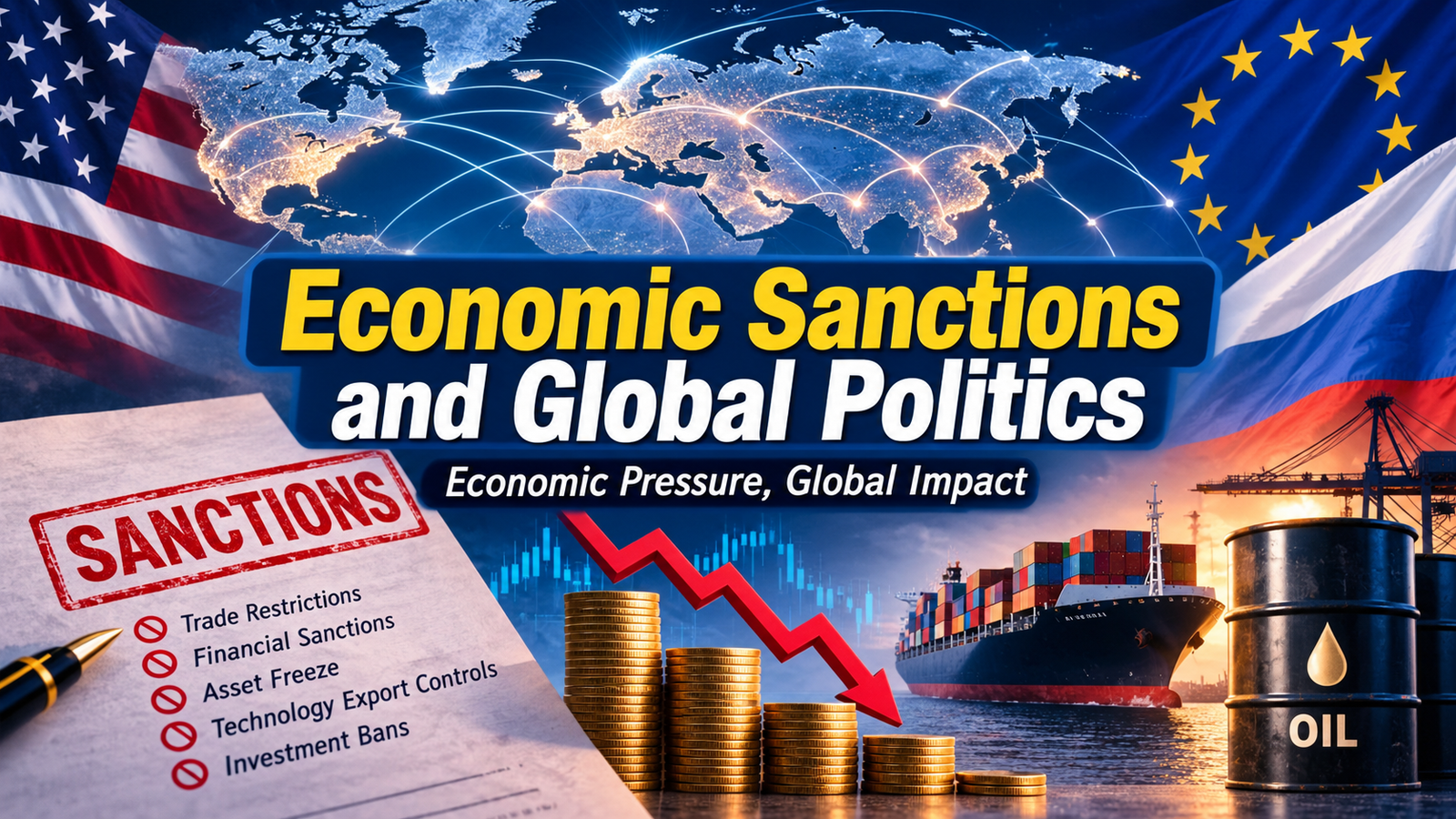
Economic sanctions have become one of the most important instruments of international politics. Governments and international organisations use sanctions to influence the behaviour of other countries without directly engaging in military conflict. These measures may include trade restrictions, financial penalties, asset freezes, export controls, investment bans, and limitations on access to international banking systems. Although economic sanctions are generally introduced for political or security reasons, their consequences extend far beyond diplomacy, affecting international trade, employment, inflation, investment, economic growth, and the welfare of ordinary citizens.
The relationship between economic sanctions and global politics reveals how economic power can be used to achieve strategic objectives. Powerful economies can restrict access to markets, technology, financial services, and essential commodities, placing considerable pressure on targeted governments. However, sanctions do not always produce the desired political outcomes. In some cases, they weaken national economies without changing government policies, while in others, they encourage domestic production, alternative trading partnerships, and new international economic alliances.
From an economic perspective, sanctions represent a conflict between political objectives and economic interdependence. Their effectiveness depends on the economic strength of the imposing countries, the vulnerability of the targeted economy, the availability of alternative markets, and the willingness of governments and populations to absorb financial losses. Understanding these factors is essential for evaluating the role of sanctions in contemporary global politics.
Table of Contents
What Are Economic Sanctions?
Economic sanctions are restrictions imposed by one country, a group of countries, or an international organisation to influence the political, military, or economic behaviour of another state, organisation, or individual. Unlike conventional warfare, sanctions attempt to create pressure through economic mechanisms rather than direct military confrontation.
Sanctions can take several forms. Trade sanctions restrict the import or export of particular goods. Financial sanctions limit access to international banking, credit, investment, or foreign currency reserves. Asset freezes prevent targeted governments, companies, or individuals from accessing specific financial holdings. Technology restrictions limit access to advanced equipment, industrial machinery, software, and strategically important components.
Sanctions may be comprehensive, covering large parts of an economy, or targeted at specific individuals, institutions, industries, and technologies. Modern sanctions increasingly combine several instruments to increase pressure while attempting to limit humanitarian consequences.
The economic logic behind sanctions is relatively straightforward. If a government depends on foreign markets for export revenue, imported technology for industrial production, or international financial networks for commercial transactions, restrictions on these activities can raise the cost of maintaining its existing policies. The resulting economic losses are expected to encourage political concessions.
However, the economic pressure created by sanctions does not automatically translate into political change. Governments may transfer the costs to households, introduce import controls, strengthen domestic industries, or redirect trade towards countries that do not participate in the restrictions.
The Economic Foundations of Sanctions
The effectiveness of sanctions is closely connected to international economic interdependence. Countries specialise in producing particular goods and services, participate in global supply chains, and depend on foreign markets for investment, energy, raw materials, and consumer products. This interdependence creates economic benefits, but it also creates vulnerabilities.
For example, a country that exports a large proportion of its petroleum may experience substantial revenue losses if major buyers stop purchasing its products. Similarly, an economy that depends on imported semiconductors, industrial machinery, or specialised software may face declining productivity when access to these products is restricted.
The theory of economic interdependence suggests that countries with greater dependence on external markets may be more vulnerable to economic coercion. Nevertheless, dependence is not always one-sided. A country supplying an essential commodity may also possess considerable bargaining power because restrictions on its exports can increase prices for importing nations.
Sanctions therefore operate through several economic channels: reduced trade, higher transaction costs, restricted investment, declining access to finance, supply-chain disruption, and increased uncertainty. Their consequences depend on how quickly businesses and governments can find substitutes for restricted products and markets.
Another important concept is the opportunity cost of sanctions. The imposing country may also lose export markets, access to inexpensive raw materials, investment opportunities, and profitable commercial relationships. Consequently, sanctions are not economically cost-free instruments of foreign policy.
How Economic Sanctions Influence International Trade
International trade is one of the first areas affected by sanctions. Import restrictions reduce the availability of foreign products, while export controls limit the ability of targeted countries to sell goods abroad. Both mechanisms can disrupt established commercial relationships.
When a major export market becomes inaccessible, domestic producers may experience declining sales, lower capacity utilisation, and reduced profitability. Industries that depend on imported machinery or intermediate goods may also face higher production costs. These problems can spread throughout the economy because modern manufacturing depends on interconnected supply chains.
For example, restrictions on Russian energy exports following the 2022 invasion of Ukraine contributed to a major restructuring of European energy markets. European countries sought alternative suppliers, while Russian energy exports were redirected towards other markets, particularly in Asia. This adjustment demonstrated that sanctions can change trade patterns without necessarily eliminating the targeted country’s export earnings.
Trade diversion is an important economic consequence. When direct trade becomes restricted, businesses may seek alternative suppliers, transport routes, intermediaries, and financial arrangements. Such adjustments can reduce the impact of sanctions, although they often increase costs and create additional uncertainty.
Sanctions may also encourage countries to form alternative trade partnerships. Over time, these developments can fragment global markets into competing economic networks, reducing efficiency and making international commerce more politically sensitive.
Financial Sanctions and the Global Banking System
Financial sanctions have become particularly influential because international commerce depends heavily on banking networks, payment systems, foreign currency reserves, and access to capital markets.
Governments can restrict selected banks from conducting international transactions, freeze certain assets, limit sovereign borrowing, or prohibit investment in particular industries. These measures can make it difficult for targeted economies to finance imports, repay external obligations, attract investment, or stabilise their currencies.
Foreign exchange restrictions can be especially damaging when a country needs imported food, fuel, medicines, or industrial inputs. If exporters cannot receive payments through conventional banking channels, trade may become more expensive or difficult to arrange.
Financial sanctions can also increase the perceived risk of investing in a targeted country. Even businesses not directly prohibited from trading may withdraw because they fear legal penalties, payment disruptions, or reputational damage. This behaviour, often described as overcompliance or risk avoidance, can make the economic impact broader than the formal restrictions themselves.
The freezing of Russian central bank assets by several Western jurisdictions after the invasion of Ukraine demonstrated the strategic significance of financial infrastructure. It also highlighted debates about sovereign reserves, the security of international financial holdings, and the long-term role of the US dollar and other major currencies in the global economy.
However, the use of financial sanctions may encourage governments to diversify reserves, develop alternative payment mechanisms, and reduce reliance on particular currencies. Such changes generally require time and do not automatically displace established international financial networks.
Inflation, Employment, and Economic Growth
One of the most direct economic consequences of sanctions is their potential effect on prices, employment, and economic growth.
When sanctions restrict imports, domestic markets may experience shortages of raw materials, consumer goods, fuel, machinery, or agricultural inputs. If alternative suppliers are more expensive, businesses may pass the additional costs on to consumers. This can contribute to inflation, particularly in economies heavily dependent on imported essential products.
Export restrictions can produce a different but equally serious problem. When domestic producers lose access to foreign customers, their revenues may fall. Companies may reduce working hours, postpone investment, or dismiss employees. Lower employment and income can then reduce household consumption, weakening economic activity further.
Sanctions can also affect long-term productivity. Restrictions on advanced technology, foreign investment, research collaboration, and specialised industrial equipment may slow modernisation. Even when a country maintains positive economic growth, its productivity potential may deteriorate if firms cannot access essential technologies.
Nevertheless, sanctions do not always cause an immediate economic collapse. Their effects vary according to the targeted country’s fiscal position, natural resources, industrial capacity, domestic demand, and access to alternative trading partners. Some governments can use public spending, currency controls, or import substitution policies to cushion the initial shock.
The distribution of economic costs is equally important. Wealthy households and politically connected businesses may be better positioned to protect their assets, while low-income households spend a larger share of their income on essential goods. As a result, sanctions can increase inequality even when their aggregate economic impact appears manageable.
Economic Sanctions and the Global Energy Market
Energy is particularly important in the relationship between sanctions and global politics because oil, natural gas, and other energy resources are essential inputs for transportation, electricity generation, manufacturing, and agriculture.
Restrictions on energy exports can reduce the revenue available to targeted governments. However, energy sanctions may also increase prices for importing countries, especially when the targeted supplier is a major producer. Higher energy costs can raise transport expenses, increase electricity prices, and make industrial production more expensive.
The economic consequences therefore extend beyond the countries directly involved. A rise in international oil or gas prices can affect countries that have no political involvement in the dispute. Developing economies with limited foreign exchange reserves may face particular difficulties because they must spend more to import the same quantity of energy.
Energy sanctions also create incentives for structural change. Importing countries may diversify suppliers, increase renewable energy investment, improve energy efficiency, or expand domestic production. Targeted countries may redirect exports towards alternative buyers, sometimes accepting lower prices or higher transport costs.
These adjustments can reduce dependence on particular suppliers over time. However, they require investment and infrastructure, meaning that the short-term costs of sanctions can be substantial even when long-term diversification produces economic benefits.
Case Study: Western Sanctions Against Russia
The sanctions imposed on Russia following its invasion of Ukraine in February 2022 provide an important example of economic coercion in contemporary international relations.
The United States, the European Union, the United Kingdom, and several other countries introduced restrictions affecting Russian banks, selected individuals, technology imports, energy transactions, investment, and access to certain international financial services. Some Russian assets held abroad were also immobilised.
The economic objectives included raising the cost of the war, limiting access to technologies needed by strategically important industries, reducing government revenue, and weakening Russia’s ability to sustain military operations.
The results have been mixed. Russia experienced significant changes in trade relationships, financial arrangements, technology access, and the structure of its economy. At the same time, energy exports were redirected towards alternative markets, domestic production was supported in selected sectors, and government spending helped sustain economic activity.
These developments illustrate a central limitation of sanctions: economic damage does not necessarily produce immediate political concessions. A government may prioritise strategic objectives over economic welfare, while alternative trading partners help it maintain a degree of external economic activity.
The sanctions have also generated costs for other economies, particularly through energy-market disruption, trade adjustments, and uncertainty. The experience demonstrates that sanctions must be assessed not only by their effects on the targeted country but also by their wider economic consequences.
Case Study: Sanctions Against Iran
Iran offers another important example of the interaction between economic restrictions and domestic economic conditions. Over several decades, sanctions imposed by the United States and other international actors have affected Iranian oil exports, financial transactions, investment, and access to international markets.
The reimposition of US sanctions after the United States withdrew from the Joint Comprehensive Plan of Action nuclear agreement in 2018 intensified pressure on Iran’s oil exports and financial relationships. Reduced access to foreign exchange, restrictions on investment, and uncertainty surrounding international transactions contributed to economic difficulties.
The economic effects have included pressure on the national currency, inflation, reduced investment opportunities, and difficulties for businesses seeking imported inputs. Households have faced higher living costs, while firms have had to navigate complex payment and supply arrangements.
However, Iran has also adapted through alternative trading relationships, domestic production, and informal or indirect commercial channels. These strategies have helped sustain some economic activity, although they cannot fully replace unrestricted access to international finance and technology.
The Iranian case highlights the difficulty of using sanctions to secure specific political outcomes. Their effectiveness depends on the clarity of the demands, the willingness of the targeted government to compromise, the credibility of sanctions relief, and the extent to which alternative economic relationships remain available.
Humanitarian Consequences and Economic Inequality
Although sanctions are generally designed to influence governments, their consequences frequently reach ordinary citizens. Reduced trade, financial restrictions, currency depreciation, and rising prices can weaken household purchasing power and reduce access to essential goods.
Humanitarian exemptions are often intended to allow food, medicine, and other essential products to reach affected populations. Nevertheless, legal uncertainty, banking restrictions, transportation problems, and excessive caution among private companies can complicate humanitarian transactions.
The economic burden is not distributed equally. Wealthier households may hold foreign assets or possess access to alternative markets, while poorer households depend more heavily on local wages and affordable consumer goods. Small businesses may also be more vulnerable than large firms because they have fewer financial resources and weaker international networks.
This raises an important economic and ethical question: if sanctions are intended to influence political leadership, should ordinary citizens bear a substantial share of the costs?
More carefully designed sanctions can attempt to reduce these effects by targeting specific decision-makers, restricting strategically important technologies, protecting humanitarian channels, and reviewing the consequences regularly. However, targeted sanctions are not automatically harmless, and their indirect economic effects must still be considered.
Do Economic Sanctions Actually Work?
The effectiveness of economic sanctions remains a major subject of debate among economists and political scientists. Sanctions can impose measurable economic costs, but the achievement of political objectives is a separate question.
Their success depends on several conditions. First, the targeted government must be sufficiently vulnerable to external economic pressure. Second, the demands made by the imposing countries must be clear and achievable. Third, the countries imposing sanctions must coordinate their policies and limit opportunities for circumvention. Finally, there must be a credible possibility that restrictions will be eased if the targeted government changes its behaviour.
Sanctions may be less effective when the targeted leadership considers the disputed issue essential to national security, political survival, or ideological legitimacy. In such circumstances, leaders may accept significant economic losses rather than make concessions.
Domestic politics also matters. Governments can portray sanctions as foreign aggression, use them to strengthen nationalist sentiment, or shift responsibility for economic problems onto external actors. This can weaken internal pressure for policy change.
Furthermore, sanctions can encourage economic substitution. Countries may develop domestic alternatives, diversify trade, strengthen relations with non-participating states, or create alternative payment arrangements. These responses do not eliminate the costs of sanctions, but they can reduce their long-term effectiveness.
Consequently, economic sanctions should not be evaluated solely by the scale of financial losses they generate. A more complete assessment considers whether they achieve their stated political objectives, how much they cost the imposing countries, whether they produce unintended consequences, and whether diplomatic alternatives could achieve better results.
The Future of Economic Sanctions in Global Politics
Economic sanctions are likely to remain an important instrument of international policy as governments seek alternatives to direct military confrontation. However, their future effectiveness will be influenced by changes in technology, trade networks, financial infrastructure, and the distribution of global economic power.
The growth of alternative payment systems, regional trade agreements, and diversified supply chains may reduce the ability of individual countries to exercise unilateral economic pressure. At the same time, restrictions on advanced semiconductors, artificial intelligence technologies, telecommunications equipment, and other strategic goods may become increasingly important.
Global supply-chain restructuring may also make sanctions more complex. A product assembled in one country may depend on components, software, finance, and raw materials from several others. Identifying the true economic impact of restrictions will therefore require increasingly sophisticated monitoring and enforcement.
Multilateral coordination will remain important. Sanctions supported by a broad international coalition can be more effective because they reduce the availability of alternative markets and financial channels. However, disagreements among major powers can weaken enforcement and encourage competing economic blocs.
The long-term challenge is to design sanctions that are proportionate, legally grounded, economically effective, and consistent with humanitarian obligations. Their use should be accompanied by clear objectives, realistic expectations, periodic review, and credible pathways for diplomatic resolution.
Conclusion
Economic sanctions demonstrate that economic power is closely connected to international political influence. By restricting trade, finance, investment, technology, and access to global markets, governments can impose significant costs without engaging in direct military conflict. Yet the economic consequences of sanctions are rarely limited to their intended targets.
Their effects can spread through global supply chains, energy markets, banking systems, employment, inflation, and household welfare. Targeted governments may adapt by redirecting trade, strengthening domestic production, or establishing alternative financial arrangements, while imposing countries may also experience higher costs and lost commercial opportunities.
The experiences of Russia and Iran show that sanctions can reshape economic relationships and constrain selected activities without necessarily achieving rapid political change. Their success depends on economic vulnerability, international cooperation, clear objectives, domestic political conditions, and the availability of realistic diplomatic solutions.
Ultimately, the relationship between economic sanctions and global politics illustrates both the power and the limitations of economic coercion. Sanctions can be useful tools of foreign policy, but they are not substitutes for sound diplomacy. Their effectiveness should be judged by their ability to achieve clearly defined political goals while minimising unnecessary economic hardship and preserving opportunities for peaceful resolution.
Frequently Asked Questions About Economic Sanctions
1. What are economic sanctions?
Economic sanctions are restrictions imposed by countries or international organisations to influence the political, economic, or military behaviour of another country. They may include trade restrictions, financial penalties, asset freezes, and technology export controls.
2. What is the main purpose of economic sanctions?
The main purpose of economic sanctions is to pressure governments to change specific policies or actions without using direct military force. They may be imposed to address military aggression, nuclear proliferation, human rights violations, or threats to international security.
3. How do economic sanctions affect the global economy?
Economic sanctions can disrupt international trade, restrict investment, increase production costs, and affect global supply chains. They may also influence currency values, energy prices, inflation, and economic growth in countries beyond those directly involved.
4. What are the different types of economic sanctions?
The major types of economic sanctions include trade sanctions, financial sanctions, asset freezes, investment restrictions, arms embargoes, and technology export controls. Some sanctions target entire economic sectors, while others focus on particular individuals, businesses, or institutions.
5. Who imposes economic sanctions?
Economic sanctions can be imposed by individual countries, groups of countries, or international organisations. The United Nations Security Council can adopt binding sanctions under the UN Charter, while countries such as the United States and members of the European Union also implement their own sanctions regimes.
6. How do economic sanctions affect international trade?
Economic sanctions restrict the movement of goods and services between countries. They can reduce export earnings, limit access to imported products, disrupt supply chains, and force businesses to find alternative suppliers or markets.
7. Can economic sanctions cause inflation?
Yes, economic sanctions can contribute to inflation by restricting imports, reducing product availability, increasing transportation costs, and raising the prices of essential commodities. The severity of these effects depends on the targeted country’s dependence on foreign goods and the availability of alternative suppliers.
8. How do economic sanctions affect ordinary citizens?
Economic sanctions can affect ordinary citizens through higher prices, reduced employment opportunities, lower purchasing power, and difficulties accessing certain goods and services. Although humanitarian exemptions may protect essential supplies, banking and logistical barriers can sometimes complicate their delivery.
9. What is the difference between economic sanctions and trade sanctions?
Economic sanctions are a broad category of restrictions designed to exert economic pressure. Trade sanctions are a specific type of economic sanction that restricts imports, exports, or commercial transactions involving particular countries, goods, or industries.
10. Are economic sanctions effective in changing government policies?
Economic sanctions can influence government policies, but their effectiveness varies. They are more likely to achieve their objectives when the targeted government is economically vulnerable, the demands are clear, and the countries imposing sanctions cooperate. However, governments may resist pressure or develop alternative economic relationships.
11. How do economic sanctions affect developing countries?
Economic sanctions can create difficulties for developing countries by increasing import costs, restricting access to international finance, reducing investment, and disrupting essential supplies. Countries that depend heavily on imported fuel, food, medicines, or industrial equipment may face particularly serious challenges.
12. What are the economic sanctions against Russia?
Following Russia’s invasion of Ukraine in February 2022, the United States, the European Union, the United Kingdom, and other countries introduced sanctions affecting Russian banks, individuals, technology imports, investment, and energy-related transactions. These measures have reshaped Russia’s international economic relationships and contributed to changes in global energy and trade markets.
13. How have economic sanctions affected Iran?
Economic sanctions against Iran have restricted parts of its oil exports, international financial transactions, investment, and access to technology. These restrictions have contributed to economic pressures, including inflation and currency depreciation, while Iran has also developed alternative trading relationships and domestic production strategies.
14. What is the difference between unilateral and multilateral economic sanctions?
Unilateral economic sanctions are imposed by a single country, whereas multilateral economic sanctions involve coordinated action by several countries or an international organisation. Multilateral sanctions can exert broader pressure by limiting access to alternative markets and financial channels, although their effectiveness depends on participation and enforcement.
15. What is the future of economic sanctions in global politics?
Economic sanctions are likely to remain an important instrument of global politics. Their future effectiveness will depend on international cooperation, alternative payment systems, global supply chains, technological competition, and the ability of governments to enforce restrictions while minimising humanitarian harm. Diplomacy will remain essential for turning economic pressure into lasting political agreements.