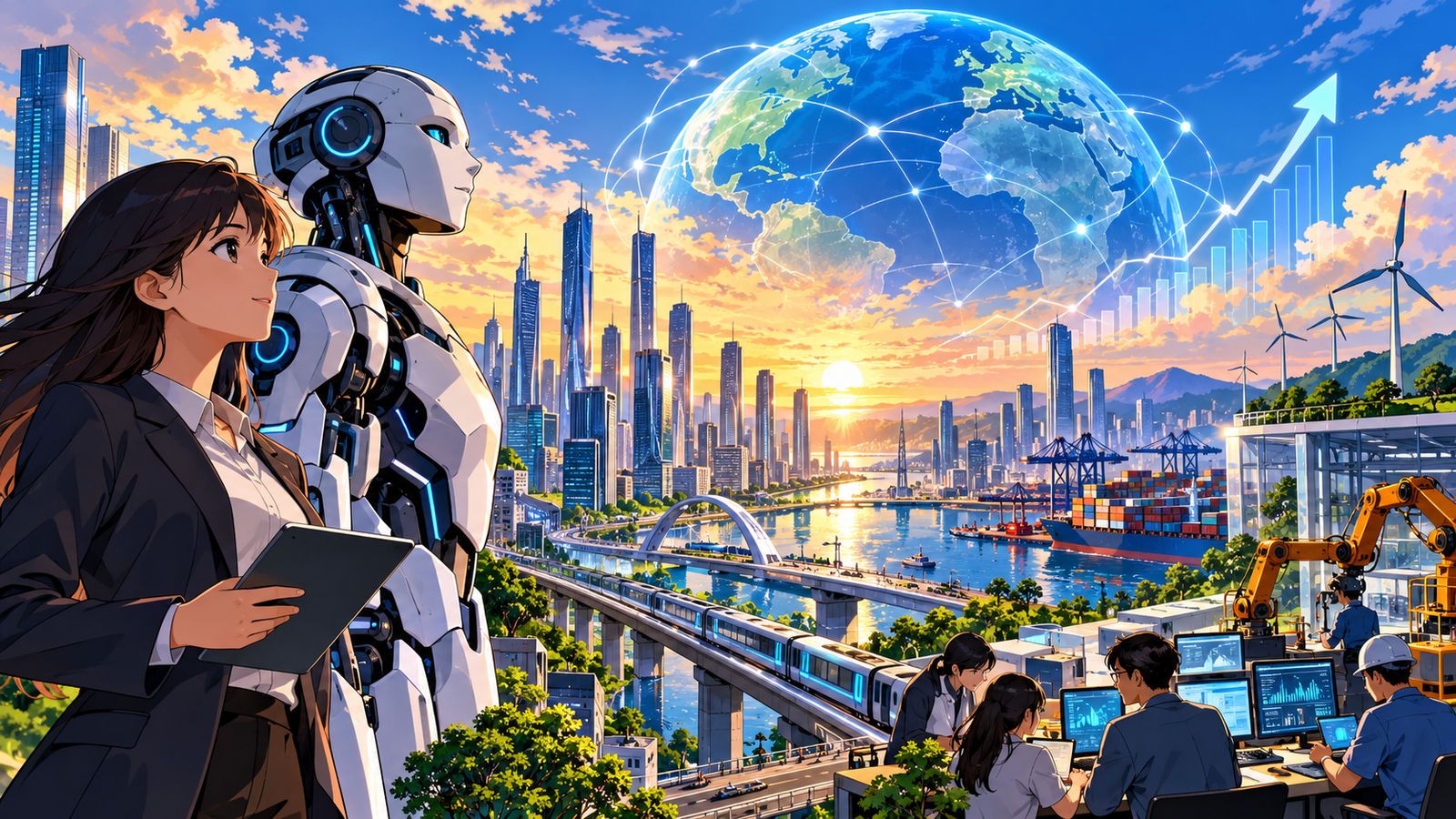
Artificial Intelligence (AI) has moved from being a specialized technological concept to becoming one of the most important forces shaping the modern economy. From automated manufacturing and algorithmic trading to generative AI, intelligent logistics, personalized education and AI-powered healthcare, artificial intelligence is changing how goods and services are produced, distributed and consumed. Its economic significance goes far beyond the technology sector because AI has the potential to influence productivity, employment, wages, investment, international trade, entrepreneurship and the distribution of wealth.
The future economy will therefore not simply be an economy with more computers or automated machines. It may represent a fundamental transformation in the way economic value is created. Traditional economic models are largely based on the interaction between land, labour and capital. AI introduces another powerful productive capability: the ability of machines and software to perform increasingly sophisticated cognitive tasks. This raises an important economic question: Will AI create a more productive and prosperous economy, or will it deepen inequality by concentrating wealth and economic power?

The answer will depend not only on technological progress but also on government policies, education systems, labour-market institutions, corporate strategies and the ability of societies to distribute the benefits of technological change.
Table of Contents
AI as a New Factor of Future Economy Production
In classical economics, production depends primarily on land, labour and capital. Later economic theories placed technological progress at the centre of long-term economic growth. Artificial intelligence can be understood as a new form of technological capital that increases the productive capacity of both physical and human resources.
Unlike many previous technologies, AI can perform tasks that involve reasoning, prediction, pattern recognition, language processing and decision support. Traditional machines mainly replaced or supplemented physical labour. AI increasingly affects cognitive labour as well.
For businesses, this means that AI can potentially reduce the time and cost required to perform many activities. A company can use AI to analyze large datasets, prepare reports, generate marketing material, detect fraud, forecast demand and assist customer service. A manufacturer can combine AI with robotics to improve production efficiency. A financial institution can use algorithms to assess risks and identify unusual transactions.
The economic importance of AI therefore comes from its ability to increase the productivity of existing factors of production. If a worker equipped with AI can complete in one hour what previously required several hours, the effective productivity of labour increases.
This creates the possibility of higher economic output without a proportional increase in labour input.
Artificial Intelligence and Future Economy Growth
One of the strongest arguments in favour of AI is its potential to accelerate Future Economy growth. Economic growth occurs when an economy increases its capacity to produce goods and services. Productivity growth is one of the most important sources of long-term improvements in living standards.
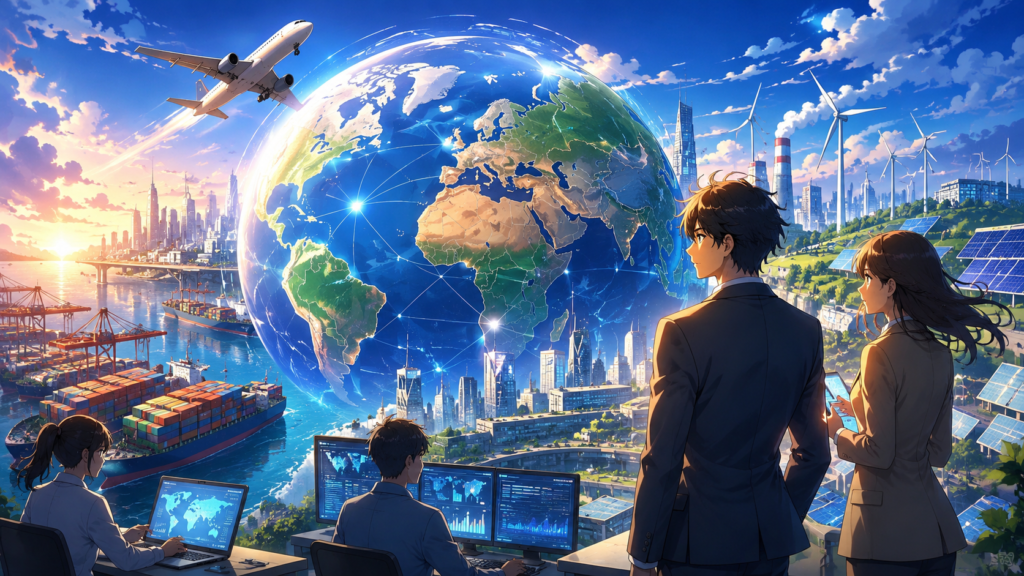
AI can contribute to productivity in several ways. First, it can automate repetitive tasks. Second, it can improve decision-making by processing enormous quantities of information. Third, it can reduce errors. Fourth, it can accelerate research and innovation. Finally, AI can create entirely new products and services.
Consider research and development. Scientists traditionally spend considerable amounts of time examining existing research, processing data and testing possible solutions. AI can help identify patterns, simulate possibilities and accelerate experimentation. If these technologies shorten the innovation cycle, new technologies and products may reach markets more quickly.
AI can also improve the productivity of small businesses. A small company that previously needed separate employees for customer support, market analysis, content production and basic administrative work may use AI tools to perform portions of these activities. This could reduce barriers to entrepreneurship and allow smaller firms to compete with larger companies.
However, productivity gains are not automatic. Businesses need appropriate infrastructure, skilled workers, quality data and organizational changes to successfully integrate AI. Investment in AI without complementary investment in education and management may produce relatively limited economic benefits.
AI and the Transformation of Employment
The relationship between AI and employment is one of the most debated issues in economics. Some economists and technology experts argue that AI will eliminate many jobs, while others believe that it will mainly transform jobs and create new forms of employment.
Historically, technological progress has both destroyed and created employment. The Industrial Revolution reduced demand for some forms of manual production while creating new industries and occupations. Computers eliminated certain clerical tasks but generated enormous employment in software, information technology, telecommunications and digital services.
AI may follow a similar pattern, although its impact could be different because it affects cognitive tasks.
Jobs involving repetitive and predictable activities are particularly vulnerable to automation. Administrative processing, basic data entry, routine customer support, simple bookkeeping and certain forms of content production may increasingly be performed by AI systems.
At the same time, new occupations are emerging around AI development, data management, AI safety, system supervision, prompt engineering, AI auditing and technology management. Existing occupations are also likely to change rather than disappear completely.
A teacher, for example, may use AI to prepare learning materials and analyze student performance while continuing to perform the human responsibilities of teaching, mentoring and motivating students. Similarly, an accountant may use AI for routine calculations and financial analysis while concentrating more heavily on interpretation, compliance and strategic advice.
The most important economic issue may therefore not be whether AI eliminates jobs completely, but whether workers can transition from declining occupations to emerging ones.
The Future of Wages and Labour Income
AI may have a major effect on wages. The impact is likely to differ significantly between occupations and skill groups.
Workers whose productivity increases substantially through AI may experience higher wages if businesses share some of the resulting economic gains with employees. Highly skilled professionals who can effectively combine their expertise with AI could become more productive and valuable.
However, there is another possibility. If AI performs tasks previously requiring highly paid workers, the demand for certain forms of skilled labour could decline. This could place downward pressure on wages in some professions.
The distributional consequences are therefore uncertain.
AI could create a situation in which a small number of highly productive workers, technology companies and capital owners capture a disproportionate share of economic gains. If productivity increases while labour income stagnates, the share of national income going to capital could rise relative to labour.
This raises an important question for future economic policy: How should the productivity gains created by AI be distributed?
The answer could involve stronger social protection, improved education, employee ownership, progressive taxation, universal public services or new mechanisms for sharing technological wealth.
AI and Income Inequality on Future Economy
Income inequality may become one of the defining economic challenges of the AI era.
AI development requires significant investment in computing infrastructure, advanced chips, data centres, research and specialized talent. Large technology companies possess substantial financial resources and access to these technologies. This could create economies of scale in which successful companies become even more dominant.
There is also a geographical dimension. Countries with advanced digital infrastructure, research institutions and highly skilled workers may benefit more rapidly from AI than countries with weaker technological ecosystems.
This could widen the economic gap between developed and developing economies.
At the individual level, workers with advanced digital and analytical skills may benefit more than workers whose jobs consist mainly of routine tasks. Consequently, AI could increase wage inequality unless education and training systems successfully broaden access to AI-related skills.
However, AI also has the potential to reduce inequality. Low-cost AI tools can provide individuals and small businesses with access to capabilities that were previously expensive. A small entrepreneur can use AI for market research, advertising, translation, customer service and product development. A student can access personalized educational assistance. A farmer can potentially use AI-powered systems for weather analysis and agricultural planning.
Therefore, AI itself does not determine whether inequality rises or falls. Economic institutions determine who gets access to AI and who captures its benefits.
Artificial Intelligence and the Future of Businesses
AI is likely to change the competitive structure of markets. Companies that successfully adopt AI may achieve lower costs, faster decision-making and better customer experiences.
Businesses are already using AI in marketing, supply-chain management, finance, customer service, recruitment and product development. In the future, AI may become a standard component of almost every major business function.
One significant consequence could be the emergence of highly automated firms with relatively small workforces but extremely high productivity. A technology company might serve millions of customers while employing far fewer workers than traditional firms of comparable economic scale.
This could increase profits and productivity, but it could also create concerns about market concentration. If a small number of companies control the most powerful AI models, computing infrastructure and data ecosystems, they may gain significant market power.
Competition policy will therefore become increasingly important. Governments may need to ensure that AI markets remain competitive and that dominant companies do not use technological advantages to unfairly restrict new entrants.
AI, Innovation and Entrepreneurship on future economy
Artificial intelligence could significantly reduce the cost of innovation.
Historically, launching a business often required access to teams of programmers, designers, researchers, analysts and marketing specialists. AI tools can now provide smaller businesses with some of these capabilities at relatively low cost.
This could create a new generation of micro-entrepreneurs. Individuals may be able to build websites, develop digital products, analyze markets and create advertising campaigns using AI-assisted tools.
The result could be an expansion of entrepreneurship.
At the same time, AI may increase competition because barriers to entry fall. When more people can create similar products quickly, businesses may find it harder to maintain competitive advantages. The economic value may therefore shift from simply producing information to developing unique brands, trusted relationships, proprietary data and innovative business models.
AI and the Global Economy
The international economic consequences of AI will be profound.
Countries that become leaders in artificial intelligence may gain advantages in productivity, defence, finance, manufacturing, healthcare and scientific research. AI could therefore become a major component of national economic competitiveness.
The United States, China and other technologically advanced economies are investing heavily in AI research and infrastructure. Other countries are also attempting to develop national AI strategies.
For developing countries such as India, AI presents both opportunities and risks.
India has a large technology workforce, a growing digital economy and a substantial services sector. AI could strengthen India’s position in software, business-process services, healthcare technology, education and digital entrepreneurship. Indian companies may increasingly provide AI-enabled services to international markets.
However, automation could also threaten some traditional outsourcing and business-process jobs. If AI systems can perform routine customer service, data processing and administrative tasks more cheaply, some existing employment models may face disruption.
India’s future success will therefore depend on whether it can move from labour-intensive services toward higher-value AI-enabled services while ensuring that workers receive appropriate training.
AI and Developing Economies
For developing economies, AI could become both an opportunity for economic acceleration and a source of new dependency.
Countries that lack advanced AI infrastructure may become dependent on foreign technology companies. This could create a new form of technological inequality.
At the same time, developing economies can use AI to address long-standing economic problems. AI-powered agricultural systems can help improve productivity. Digital financial services can expand access to credit and banking. AI-supported healthcare can assist medical professionals in underserved regions. Educational technologies can help overcome shortages of qualified teachers.
The key challenge is affordability and accessibility.
If AI remains concentrated among wealthy corporations and countries, it could widen global inequality. If developing economies can access affordable AI infrastructure, skills and open technologies, AI could help them accelerate development.
AI and the Changing Nature of Consumer Markets

AI will also transform consumption.
Consumers are increasingly receiving personalized recommendations for products, entertainment, news and services. In the future, AI assistants may become important intermediaries between consumers and businesses.
Instead of searching through hundreds of products, consumers may simply describe what they need and allow an AI system to compare options.
This could make markets more efficient because consumers can obtain information more quickly. However, it also creates concerns about manipulation and information asymmetry. If AI systems influence purchasing decisions, the companies controlling those systems may gain significant power over consumer behaviour.
The future consumer economy will therefore depend heavily on questions of transparency, privacy and algorithmic accountability.
AI and the Financial Sector of future economy
Finance is another area where AI is likely to have a major economic impact.
Banks and financial institutions can use AI for fraud detection, credit assessment, risk management, market analysis and customer service. AI can process financial information much faster than traditional systems.
Algorithmic trading already demonstrates how technology can transform financial markets. Future AI systems may make increasingly complex financial decisions.
However, greater dependence on automated systems also introduces systemic risks. If many financial institutions rely on similar AI models, errors or unexpected market reactions could spread rapidly.
Financial regulation will therefore need to evolve alongside AI.
The Environmental Economics of AI
AI has economic benefits, but it also has environmental costs.
Large AI models require substantial computing power. Data centres consume electricity and water, while semiconductor production requires significant resources.
The environmental cost of AI must therefore be included in economic analysis.
If AI increases productivity but dramatically increases energy consumption, its net economic benefit may be smaller than expected. On the other hand, AI could help reduce environmental costs by improving energy efficiency, optimizing transportation, predicting equipment failures and supporting renewable-energy systems.
The future economic value of AI will partly depend on whether technological development becomes more energy-efficient.
Education and Human Capital in the AI Economy
Education may become the most important economic policy for adapting to AI.
Traditional education systems often focus on memorization and standardized knowledge. In an AI economy, information itself becomes increasingly accessible. The more valuable skills may include critical thinking, creativity, communication, problem-solving, collaboration and the ability to evaluate information.
Students will need to learn how to work with AI rather than simply compete against it.
Governments and educational institutions will also need to promote lifelong learning. A person may need to update their skills several times during their working life.
This represents a major economic investment, but it may be necessary to prevent technological unemployment and social instability.
Government Policy and the AI Economy
Governments will play a central role in determining how AI affects society.
A balanced policy framework should encourage innovation while protecting workers, consumers and competition. Excessive regulation could slow technological development, while insufficient regulation could allow monopolies, discrimination and economic exploitation.
Tax policy may also become increasingly important. If automation reduces labour demand and increases returns to capital, governments may need to reconsider how economic activity is taxed.
However, taxing AI or automation directly could discourage productivity-enhancing investment. A better approach may involve strengthening broader tax systems and using revenues to finance education, healthcare, infrastructure and social protection.
Universal basic income is sometimes proposed as a response to large-scale automation. Whether such a system is economically sustainable remains debated. Alternative approaches include wage subsidies, negative income taxes, unemployment insurance and stronger public employment programmes.
The appropriate policy will depend on the scale and speed of technological disruption.
Will AI Create a Post-Work Economy?
One of the most ambitious questions about AI is whether technological progress could eventually reduce the necessity of human labour.
If machines become capable of performing a very large proportion of economically valuable tasks, traditional employment could become less central to economic life.
However, this scenario remains uncertain.
Human preferences create new forms of demand. Even if AI can produce information cheaply, people may continue to value human creativity, personal interaction and authenticity. Economic activity may shift rather than disappear.
The future may therefore involve shorter working hours rather than the complete disappearance of work. If productivity increases substantially, societies could potentially choose to use the gains to increase leisure, improve public services or raise living standards.
This would represent a major transformation in the relationship between productivity and human welfare.
Conclusion on future economy
Artificial Intelligence is likely to become one of the most influential technologies in the economic history of the twenty-first century. Its effects will extend far beyond automation. AI has the potential to increase productivity, accelerate innovation, reduce business costs, create new industries and improve the efficiency of markets.
At the same time, it could disrupt employment, increase inequality, strengthen corporate concentration and create new forms of technological dependence.
The central economic question is therefore not simply whether AI will create growth. It is who will benefit from that growth.
If AI remains concentrated among a small number of corporations, investors and technologically advanced countries, its benefits may be accompanied by greater economic inequality. If access to AI is widely distributed through education, infrastructure, competitive markets and responsible public policy, it could become a powerful instrument for broad-based development.
The future economy will probably not be an economy without human workers. Instead, it is likely to be an economy in which human labour and artificial intelligence become increasingly interconnected. Workers who learn to use AI effectively may become more productive, while businesses that integrate AI responsibly may gain significant competitive advantages.
For developing economies such as India, the challenge is especially important. AI can become a tool for economic modernization, entrepreneurship and productivity growth, but only if investment in technology is accompanied by investment in people.
Ultimately, artificial intelligence is not an economic destiny. It is a technology whose economic consequences will be shaped by institutions, markets, governments and society. The future economy will therefore depend not merely on how intelligent machines become, but on how intelligently humanity manages the economic transformation created by them.
FAQs About the Future Economy
1. What is the future economy?
The future economy refers to an economic system increasingly shaped by artificial intelligence, automation, digital technologies, advanced data systems and new forms of innovation.
2. How will AI affect the future economy?
AI is expected to influence productivity, employment, business operations, investment, consumption, international trade and economic growth. It may also create entirely new industries and occupations.
3. Will AI create more jobs in the future economy?
AI is likely to eliminate some routine jobs while creating new occupations. The overall employment impact will depend on the speed of automation, economic growth and workers’ ability to develop new skills.
4. Will AI increase economic growth?
AI can increase economic growth by improving productivity, reducing production costs, accelerating innovation and allowing businesses to produce more goods and services with existing resources.
5. How will AI affect wages in the future economy?
The effect on wages will vary. Workers who effectively use AI may become more productive and receive higher wages, while workers performing easily automated tasks may face wage pressure.
6. Will the future economy increase inequality?
AI could increase inequality if its economic benefits are concentrated among technology companies, investors and highly skilled workers. However, accessible AI technology and effective public policies could distribute its benefits more broadly.
7. How will AI affect developing countries?
AI could help developing countries improve agriculture, healthcare, education, finance and business productivity. However, countries lacking infrastructure, investment and skilled workers could face technological disadvantages.
8. What role will education play in the future economy?
Education will be crucial because workers will need skills such as critical thinking, creativity, digital literacy, problem-solving and AI collaboration. Lifelong learning will become increasingly important.
9. Will AI replace human workers completely?
AI is unlikely to replace all human workers. In many occupations, AI will probably complement human capabilities rather than completely replace them, particularly where human judgment, creativity and interpersonal skills remain important.
10. How will businesses change in the future economy?
Businesses are likely to become more automated and data-driven. AI may be integrated into marketing, finance, customer service, production, logistics, recruitment and strategic decision-making.
11. How will AI affect small businesses?
AI can lower the cost of services such as marketing, market research, customer support, content creation and data analysis. This could allow small businesses and entrepreneurs to compete more effectively.
12. What is the relationship between AI and productivity?
AI can increase productivity by allowing workers and businesses to complete tasks faster, reduce errors, analyze large quantities of information and automate repetitive activities.
13. How will governments respond to the future economy?
Governments will need to develop policies covering AI regulation, education, taxation, competition, worker protection, data privacy and social security while continuing to encourage technological innovation.
14. Will AI change global economic competition?
Yes. Countries with strong AI infrastructure, research capabilities, skilled workers and investment may gain significant advantages in productivity, innovation and international competitiveness.
15. What will determine the success of the future economy?
The success of the future economy will depend on how effectively societies combine technological innovation with education, infrastructure, competitive markets, responsible regulation and equitable distribution of economic benefits.